
Hi, furends! 🐾
Today I’m bringing you my Doggie Language book review—a book that teaches humans how to understand dogs.
As a dog, I was naturally interested in seeing how well you people are doing.
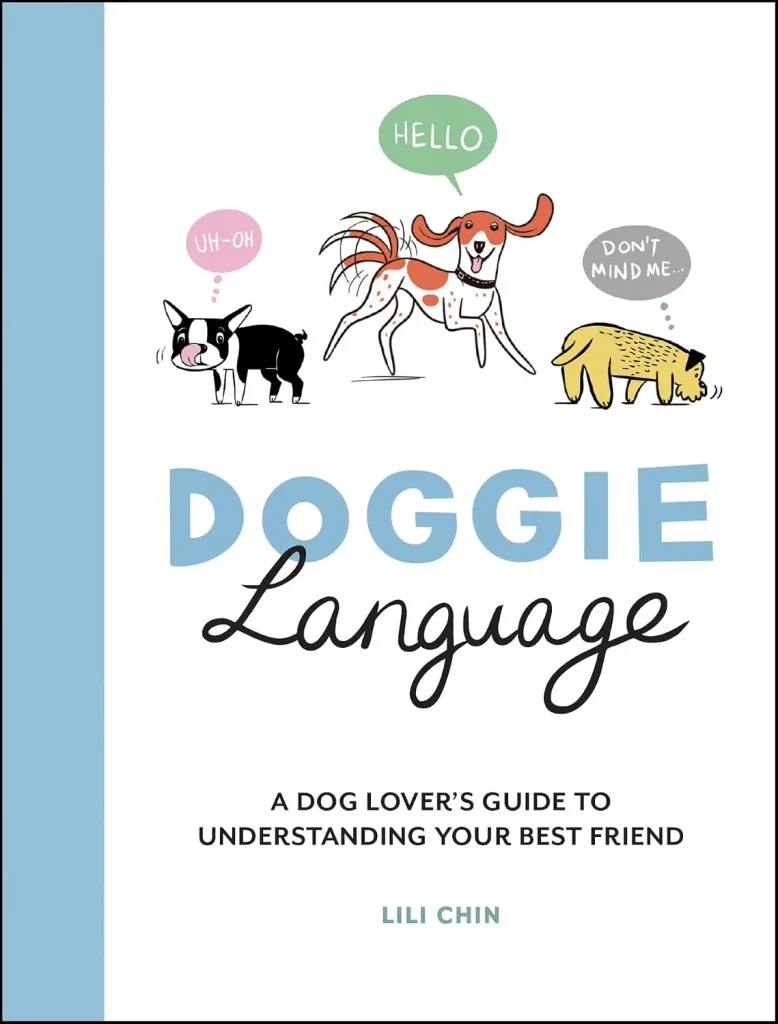
Doggie Language: A Dog Lover’s Guide to Understanding Your Best Friend by Lili Chin is a small, quick-to-read book filled with illustrations showing the many ways dogs communicate through our faces and bodies. And Mom says not to let the fact that it’s an easy read fool you—there is a LOT of information packed into these pages.
Apparently, we dogs have been saying quite a bit while you humans weren’t paying attention.
One of the most important lessons throughout the book is that you can’t look at just one part of a dog and decide what he’s feeling. You need to look at the whole dog—eyes, ears, mouth, tongue, tail, posture, movement—and consider what is happening around him at the time.
Even very small differences can matter.
Take tongues, for example. A relaxed tongue hanging loosely out of the side of a dog’s mouth can communicate something very different from a tense, wide “spatula tongue.” Mom says learning to notice distinctions like that has stayed with her through multiple readings of this book.
And sometimes humans completely misunderstand what we’re telling them.
You know those videos where a human thinks a dog “looks guilty” after doing something naughty? What looks like guilt may actually be a dog who is anxious about the human’s behavior and is offering signals intended to calm the situation.
In other words, sometimes the dog isn’t saying, “I confess.”
He’s saying, “Could everybody please calm down?”
Mom has also been paying closer attention to something Magnum and I do.
Sometimes she gets right in our faces to give us kisses. Because apparently having a Great Dane means occasionally being overwhelmed by an uncontrollable need to smooch him.
When Magnum or I start licking ourselves while she’s doing this, that can be a signal that we’re not entirely comfortable with the personal-space invasion at that particular moment.
Mom’s interpretation used to be approximately: Dog. Must kiss.
Now she’s trying to listen when we politely say: Perhaps not right now, Mother.
See? The book is already improving human behavior.
It has also made Mom think more about my book events. Most of the time, my signals are pretty obvious: I’m curious about the people walking past our booth, I approach them, and I actively ask for their attention.
I am, after all, a celebrity.
But Mom knows she still needs to watch what I’m telling her throughout the day. Just because I wanted to meet the last person doesn’t automatically mean I want to meet the next one. I get to have an opinion, too.
Doggie language isn’t only about recognizing when we’re uncomfortable, though. It can also help humans understand when we’re having a great time.
When Magnum and I play, Mom watches to make sure we’re both still enjoying ourselves. We pause. We sniff each other. We take little breaks and then choose to start playing again.
I have also been known to butt-bump Magnum. Mom finds this disproportionately entertaining.
One reason Mom recommends Doggie Language so highly is that the illustrations make all these little differences easy to see. Things humans might ordinarily overlook become much more obvious when Lili Chin puts them side by side.
And this isn’t just a book for people who are new to dogs.
Mom has lived with dogs for many years. She’s read this book more than once. She still notices things when she reads it again.
That’s how subtle our language can be.
So whether your first dog just moved into your house or you’ve spent your entire life surrounded by us, Mom and I think Doggie Language belongs on your bookshelf. It’s short, approachable, fascinating—and it may change the way you look at the dog sitting beside you.
And your dog has been waiting for you to catch up.
If this book leaves you wanting to learn even more, Mom also highly recommends On Talking Terms with Dogs: Calming Signals by Turid Rugaas. Lili Chin mentions Rugaas in the foreword to Doggie Language, and Rugaas’ book takes you deeper into the fascinating ways dogs use calming signals to communicate with each other, and how humans can sometimes use those signals to communicate with dogs.
The more humans learn our language, the better you can listen when we tell you what we need.
Which seems only fair.
We’ve spent thousands of years learning your language.
🐾 Sig Shue
Great Dane • Author • Book Critic • Bilingual in Dog and Human • Still Waiting for Lili Chin to Add the Diagram for “I Am Hungry, But Not for the Food You Have Provided”