
Hi, furends! It’s Sig, and today I read a book about many different kinds of animals, many of which I have seen on my own property.
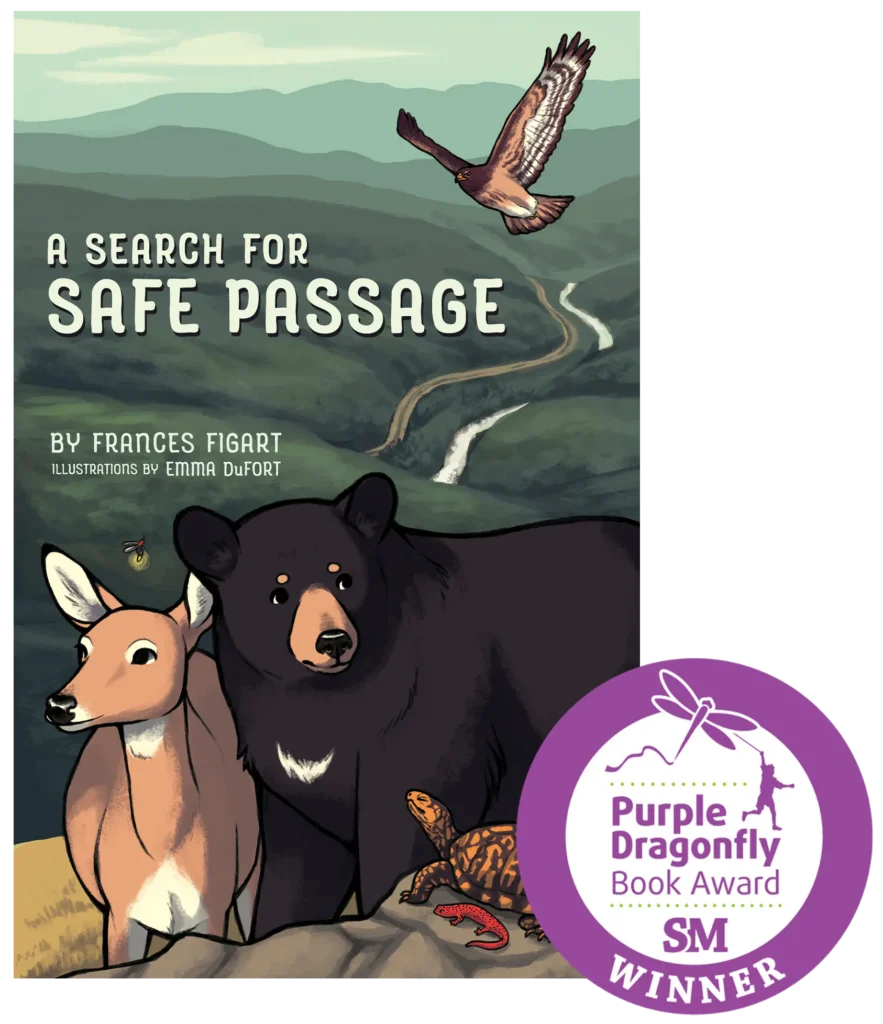
A Search for Safe Passage by Frances Figart takes place in the Appalachian Mountains, where Bear and his wildlife neighbors have a problem. Their home has been divided by the Human Highway, where speeding metal boxes on wheels make getting from one side of their habitat to the other dangerous—and often deadly.
And crossing the highway isn’t the only problem.
When roads divide the land, animals can also become separated from the food, homes, and other members of their species they need to survive. The problem affects everybody from big animals like Bear, Deer, and Elk to some of the smallest residents of the forest, including Salamander, Frog, and Firefly.
Fortunately, Appalachian animals know something humans occasionally forget:
Big problems are easier to solve when everybody works together.
Bear and his neighbors search for a way to travel safely between the north and south sides of their home without crossing the Human Highway. Along the way, animals with very different abilities and perspectives contribute to the solution. Eventually, they discover not one but two possibilities—a culvert underneath the highway and a land bridge over the top.
(I personally vote for the land bridge. I am a Great Dane. Culverts seem suspiciously small.)
But the animals’ story is only the beginning of this book.
After the fictional adventure, A Search for Safe Passage introduces readers to the real Appalachian wildlife represented by the characters. Each animal gets its own page with a photograph and information about the species. That means you can meet Bear, Turtle, Bobcat, Raccoon, Owl, Salamander, Coyote and all their neighbors again—this time in the real world.
The final section explains the real problem behind the story: roads can divide wildlife habitat and make it harder and more dangerous for animals to move through the places they need to survive.
Readers also learn about wildlife crossings and the different ways humans can help animals safely travel over or under roads. The book even looks at the advantages, limitations, and costs of different kinds of crossings.
So A Search for Safe Passage is really three books in one: an Appalachian animal adventure, an introduction to the wildlife that lives there, and a lesson in how humans can make the world they share with animals a little safer.
I especially liked that the story doesn’t have one superhero animal who saves everybody. Bear can’t solve the problem by himself. Neither can Turtle, Hawk, Salamander, Fox, or any of the others. They need animals who climb, fly, hop, slither, dig, and walk on four legs.
Everybody knows something somebody else doesn’t.
That’s a pretty good lesson for humans, too.
And if you happen to live here in Appalachia like I do, you may look at the woods beside the road a little differently after reading this book. There could be an entire neighborhood of animals back there trying to get somewhere—and hoping the next speeding metal box isn’t headed their way.
Maybe we humans and animals aren’t really asking for such different things after all.
We’d all like a safe way home. ❤️
🐾 Sig’s Paw of Approval
Reviewed by Sig Shue, Great Dane, children’s book author, Appalachian resident, and firm believer that squirrels should use designated crossings instead of running directly in front of the car.